How Rising Petrol Prices Are Driving Demand for Bajaj Chetak Electric in Nepal





Fuel prices rarely move in silence in Nepal. A revision at the pump is never just a number change—it quickly filters into daily conversations, commute decisions, and now, increasingly, what people choose to buy. The two-wheeler market is beginning to reflect that shift more clearly than ever.
Electric scooters, once discussed largely as an alternative technology story, are now being pulled forward by something far more immediate: rising petrol prices amid global supply disruptions.
According to Abhimanyu Golchha, Director at Golchha Group, the authorised distributor for Bajaj two-wheelers in Nepal, the nature of demand itself has changed in the last few months.

“The numbers speak for themselves. Electric two-wheelers have seen rapid growth this year, especially in the past two months,” he says. But what stands out is not just growth—it is the reasoning behind it. “We are not seeing a spike in curiosity. We are seeing a fundamental change in how Nepali consumers think about personal mobility.”
That change is increasingly anchored in cost logic. As petrol prices climb, daily running costs of internal combustion scooters are becoming harder to ignore. Electric scooters, on the other hand, are being evaluated through a much simpler lens: what does it cost to run, not just to buy.
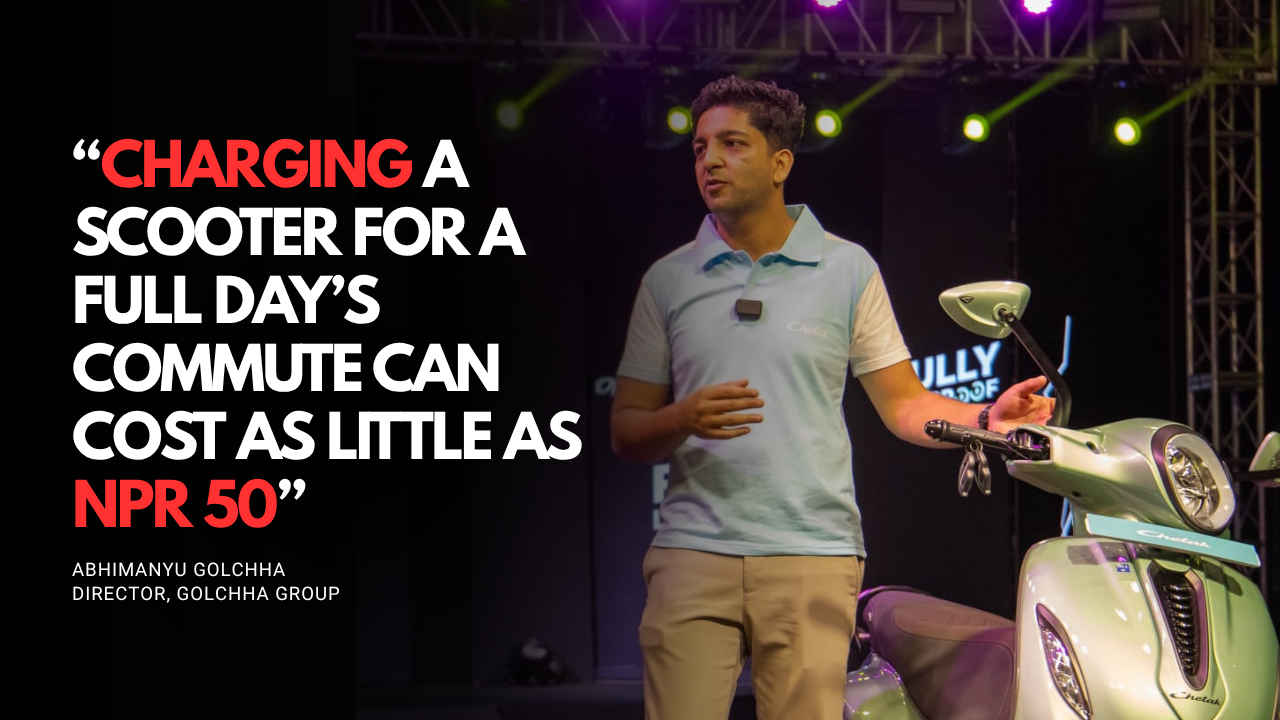
“Charging a scooter for a full day’s commute can cost as little as NPR 50. That is a number people remember,” Golchha notes. It is this predictability—against fluctuating fuel prices—that is quietly reshaping consumer behaviour.
The conversation, he says, is shifting. “It is moving from what does it cost to buy, to what does it cost to own.”
Over a three to five-year period, the economics increasingly favour electric mobility. Lower running costs, minimal maintenance, and fewer mechanical components are gradually narrowing the psychological gap created by higher upfront prices. That gap still exists—but it is no longer the deciding factor it once was.
Part of that upfront difference is visible in models like the Bajaj Chetak 3501, priced at Rs 3.24 lakh in Nepal. Positioned in the premium segment of the growing EV scooter market, the Chetak is not competing as a low-cost alternative but as a more refined urban mobility option.
It offers a certified range of 153 km on a single charge, which is enough for typical daily urban usage without frequent recharging. A full charge cycle from 0 to 80 percent takes around three hours, making it compatible with home or office charging routines that are slowly becoming more common in cities.
The scooter also leans heavily into practicality and tech integration. It comes with 35 litres of under-seat storage, a 5-inch TFT display with navigation and controls, and connected features such as geo-fencing, accident detection, and anti-theft alerts. In effect, it positions itself less as a conventional scooter and more as a connected urban mobility device.
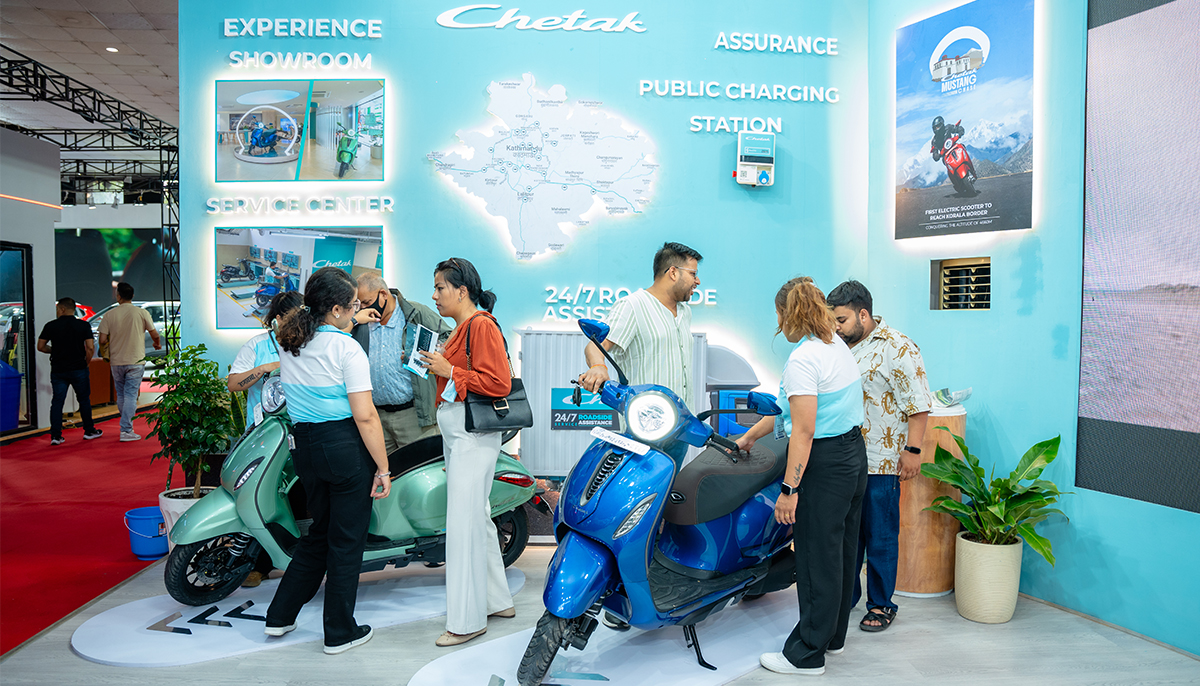
Visitors explore Bajaj Chetak at NAIMA Nepal Mobility Expo 2025 (file photo)
On the infrastructure side, one of the biggest challenges—charging availability—is starting to ease. Nepal now has more than 1,200 charging stations, improving usability confidence in urban areas and along key corridors. Financing options are also helping soften the impact of higher entry prices.
Still, as demand rises, new pressures are becoming visible. Supply consistency and wider distribution remain challenges, especially outside major cities. But industry players are not framing this as urgency-driven disruption.
“This is not a passing phase that we need to rush to capture,” Golchha says. “This is a structural shift in how Nepal will move, and we are building for that long game.”
What is unfolding in Nepal’s electric scooter market is no longer speculative. It is being shaped by fuel volatility, improving infrastructure, and a more cost-conscious consumer mindset.
Petrol prices may have triggered the shift—but it is the economics of ownership that are now keeping it in motion.